
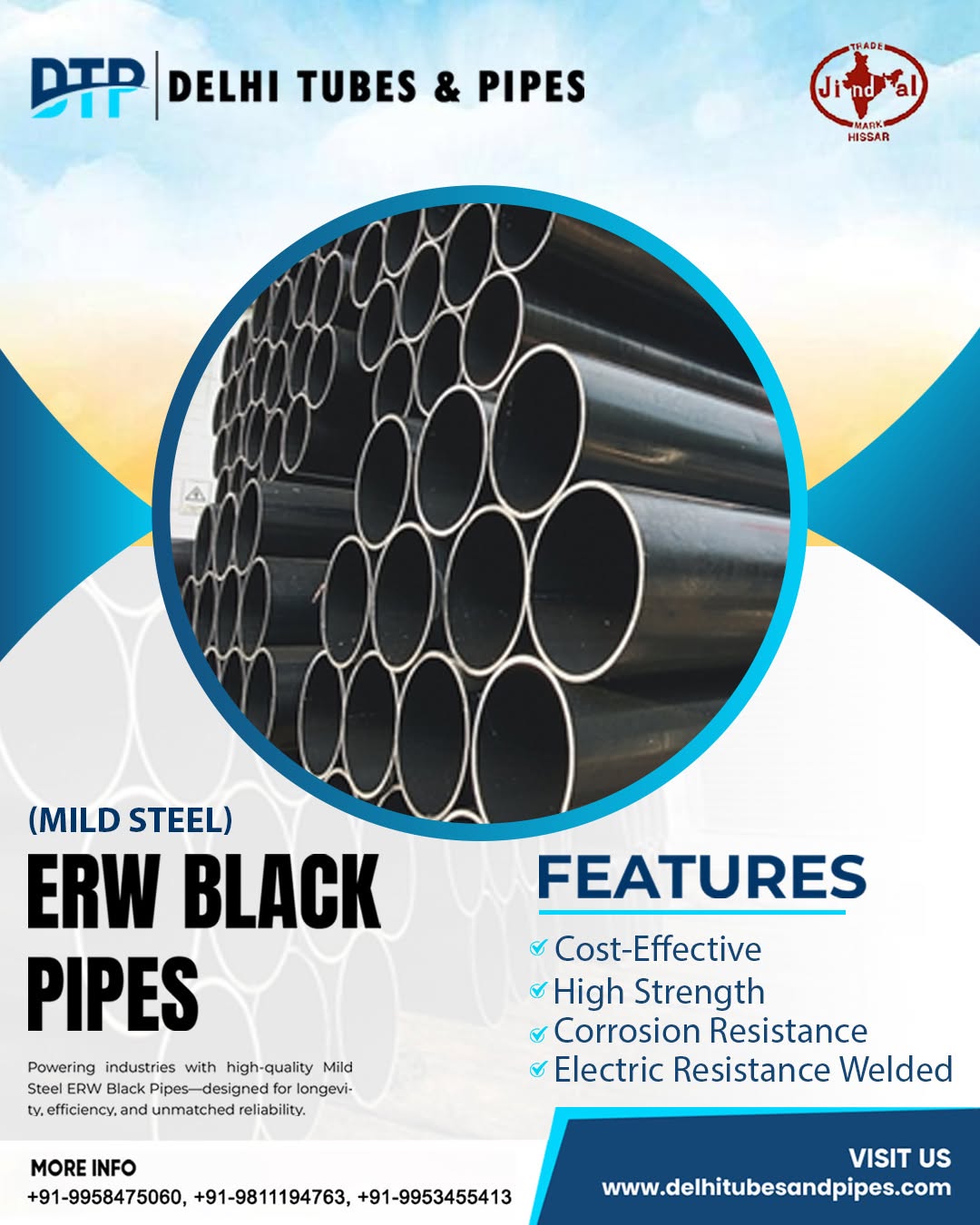
Steel pipes are required in many demanding conditions. Water supply systems in urban planning, supporting the primary members in industrial and commercial sheds, are some of the common applications that require steel pipes with enough tensile strength and resilience. Though there are various technologies that can be applied to develop pipes, ERW has been the most reliable one. Jindal Hissar Steel Pipes are made with this technology as it meets the requirements of construction, infrastructure, agriculture, and engineering.
What is ERW Technology
ERW is a widely adopted manufacturing process used in steel pipe development. In this process, steel pipes are obtained by gradually converting flat steel strips into a cylindrical shape. A series of forming stands rolls the strip into a tube shape till the edges meet. Here, no filler material or fastener is added. The pipes are joined by the Electrical Resistance Welding (ERW) process. In this mechanical process, edges are heated by a high magnitude current and pressure joins the edges. The welded seam is a strong longitudinal part of the pipe. Though the heat source is electrical, the process itself is mechanical because it involves physical concepts like forging pressure, material deformation, heat transfer, etc.
Benefits of ERW in Manufacturing Steel Pipes
The automated process of ERW manufacturing has many benefits for the steel pipes. Some of the major ones are:
Accurate Dimensions
Pipe dimensions clearly define how the pressure handling performance will be. Tight tolerances are essential in every application of steel pipes. The precise formation ensures the accurate wall thickness, straightness and diameter of the pipe.
Strong Weld
Welding zone is the most critical part of any metallic structure. The steel pipes made from ERW have a strong welding seam due to high-pressure bonding. Its strength is reliable for handling long-term fluid pressure in oil and gas refineries, construction and general engineering.
Smooth Internal Surface
Friction losses in the speed of fluid occur when the internal surface is not smooth. The quality-controlled manufacturing process maintains smoothness in the internal surface of the steel pipes produced.
Consistent Properties
The process of applying ERW technology is automated, hence the Jindal Hissar Steel Pipes remain consistent over the high volume production. The performance is predictable through the uniform characteristics of the pipes with the same configuration.
Applications That Benefit from ERW Steel Pipes
There are many industrial projects, construction works and manufacturing processes that rely on precise steel pipes.
- Plumbing and drainage
- Steel Structural Construction
- Fabrication Works
- Fire protection networks
- Irrigation
- Scaffolding
- Oil and gas infrastructure
Conclusion
For any project that involves the use of steel pipes, choose a supplier that distributes quality-tested, industrial-standard pipes. Understanding the technology behind the pipe, the level of testing and how the supplier maintains the supply chain are all important when purchasing. Delhi Tubes & Pipes is a well-experienced distributor of Jindal Hissar Steel Pipes. We supply GI pipes, API Line Pipes in a wide range of nominal bore sizes.
