
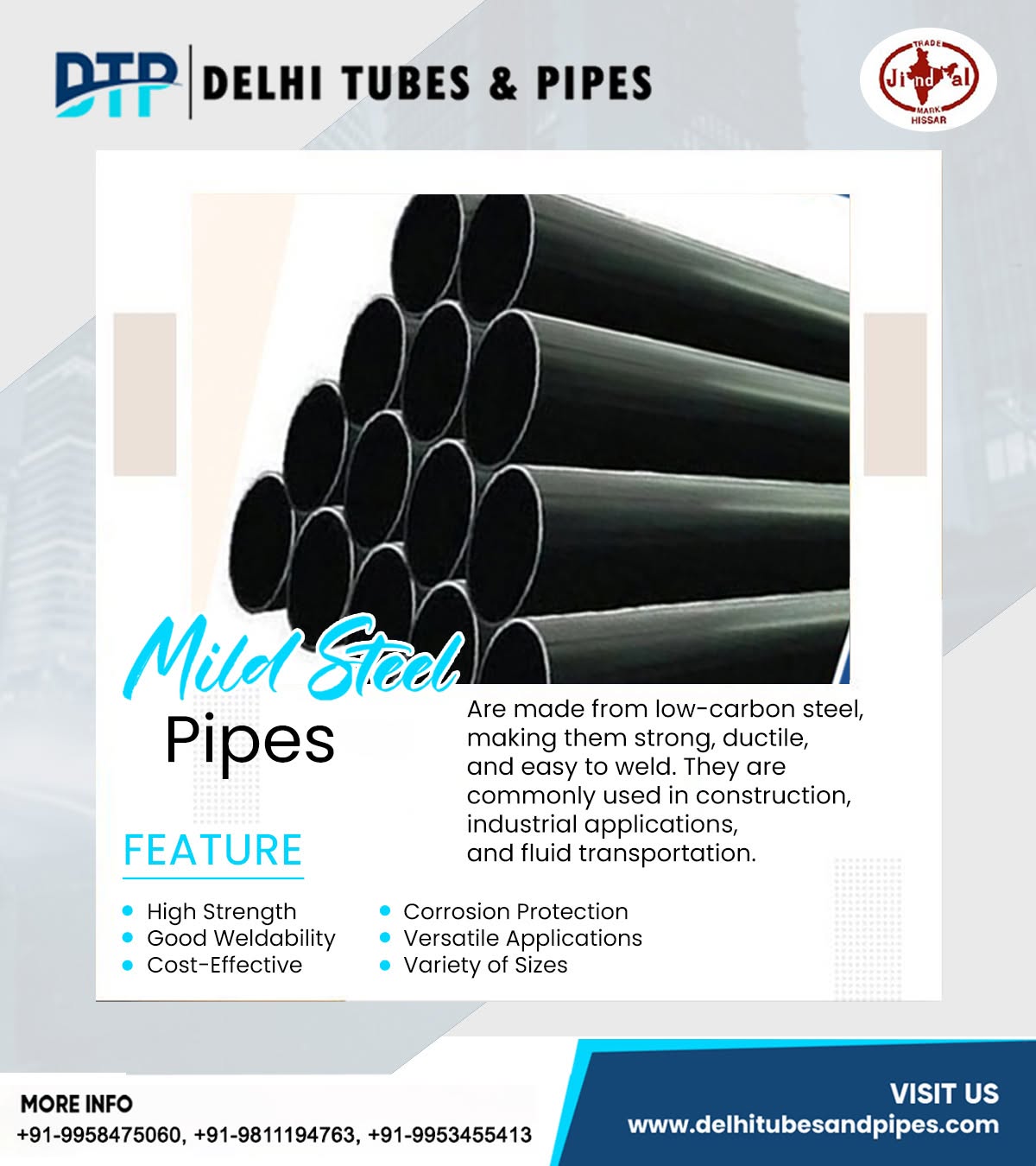
Whether you are constructing a residential building, warehouse, factory, or commercial complex, the quality of your MS pipes matters the most. These pipes support multiple applications due to their excellent load-bearing capability, high-grade quality, and lasting durability. But one must understand that similar pipes cannot be used in different applications even if they look similar from the outside. This is because they differ in thickness as well as in load-handling. Choosing the wrong one often results in higher maintenance costs, premature failure, and project delays.
To ensure that contractors and builders invest in the right MS pipe for their construction project, we are sharing a few factors in this blog. Selecting pipes based on those factors helps one buy the best quality mild steel pipes.
Buy according to their use in a construction project
The first step in choosing the right mild steel pipe is understanding where it will be used. Structural frameworks, industrial fabrication, water supply lines, fencing, and scaffolding all require different pipe features. Evaluating the requirement beforehand will save you from making the wrong investment.
Check the pipe size and thickness
The strength of an MS pipe largely depends on its diameter and wall thickness. Thicker pipes are suitable for heavy-load applications, while lighter pipes may work well for general fabrication. One must always follow the engineering drawings and project specifications instead of selecting lower thickness pipes simply to reduce costs.
Look for BIS standards and material quality
Before purchasing, verify that the MS pipes comply with relevant BIS standards such as IS 1239 or IS 3589, depending on the application. These standards help ensure dimensional accuracy, weld quality, and reliable mechanical performance. It reduces the chances of failure during installation or operation. Manufacturers like Delhi Tubes & Pipes always offer quality-tested and certified pipes manufactured using premium-grade mild steel.
Consider the installation environment
Construction sites differ in environmental conditions, and accordingly the requirement of pipe also varies. Pipes used outdoors or in humid areas are more exposed to corrosion. In such cases, these pipes require protective coatings or galvanization to improve overall durability. Investing in them without knowing where they will be installed may increase maintenance and replacement costs frequently.
Check if they offer customized pipes
Depending on the construction projects, standard pipes may not be suitable for all applications. That is when the need for customization occurs. Ask the manufacturer if they offer MS pipe with customized thickness, grade, or size, so that you can get the desired pipe. Along with that, do ask if they can fulfil bulk requirements and on time so that you do not face delay in your construction project.
Common buying mistakes to avoid
Many buyers compare only prices while ignoring important factors such as pipe grade, thickness, quality standards, and supplier credibility. Spending slightly more on certified, high-quality MS pipes often reduces repair and replacement costs in the long run.
Conclusion
One must understand that when looking for the right MS pipes, cost should not be the only consideration. Instead, consider construction application, dimensions, quality standards, environmental conditions, and customization availability to ensure that you invest in the best MS pipe. It will help improve structural performance and reduce long-term maintenance costs. We at Delhi Tubes & Pipes meet all the above-stated requirements and ensure that our clients receive quality pipes to support all their construction projects for a long time.
FAQs – Frequently Asked Questions
The ideal MS pipe depends on the application, load requirements, diameter, and wall thickness specified in the project.
Yes, with proper protective coating or galvanization, they can perform reliably in outdoor environments.
Check for BIS compliance, accurate dimensions, uniform welds, smooth surface finish, and supplier documentation.
